Execution Visibility | Field Notes #006
We’re Redesigning Work. Do We Understand What We’re Changing?
October 14, 2026
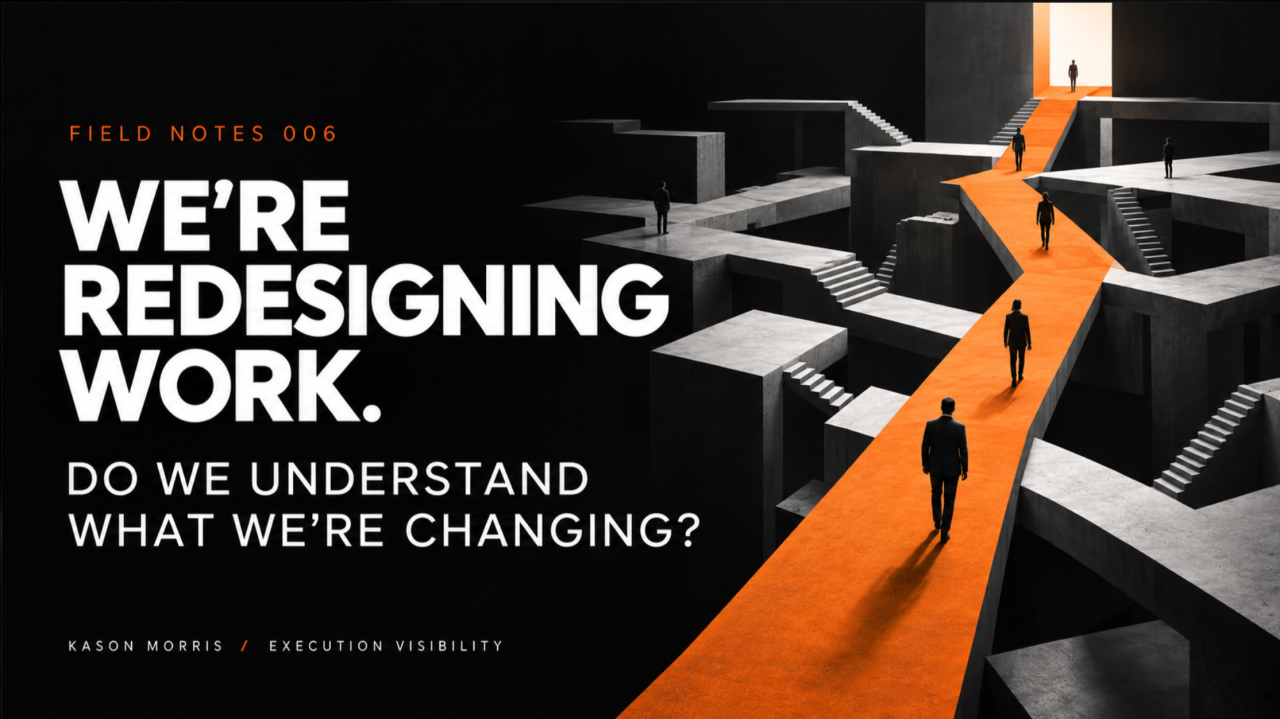
AI adoption is accelerating. But as organizations move from introducing tools to redesigning work, a more consequential question is emerging: What are we actually trying to create, and do we understand the work well enough to get there?
Last Thursday, I was in a conversation about AI adoption when a leader shared a number that caught my attention: upwards of 80%. By most measures, that’s impressive progress. Organizations have spent years trying to get employees to embrace new technologies, and here was an example of adoption reaching a level many would have considered ambitious not long ago.
But as the discussion continued, I found myself thinking about what that number actually told us. Were people making better decisions? Was work moving more effectively across teams? Could the organization point to meaningful improvements in business performance beyond the productivity gains individual employees were experiencing?
Later that evening, I joined a smaller, cross-industry conversation about human judgment. We talked about how people develop expertise, the experiences that teach us to make difficult decisions, and what happens when technology begins performing work that previously helped people learn.
The conversations approached AI from different directions. One explored what technology was making possible. The other raised questions about what people still need to experience to become capable of doing their work well.
Both left me thinking about the same challenge: we’re making significant progress in what AI can do, but I’m less certain we’re making the same progress in understanding everything that changes when we put it to work.
That distinction matters as organizations move beyond introducing AI tools and begin redesigning how work actually gets done.
Movement Doesn’t Tell Us Where We’re Going
Most organizations have established some direction for AI. They’re investing in technology, encouraging experimentation, developing skills, and identifying opportunities to automate work. Genuine progress is happening, and adoption is an important part of that story.
But adoption tells us how widely a technology is being used. It doesn’t necessarily tell us whether the organization is becoming more effective.
BCG’s 2026 AI at Work research illustrates the challenge. Among frontline employees who regularly use AI, 42% report saving at least eight hours a week. Yet 66% say they receive limited or no guidance about what to do with the time they’ve saved.
Eight hours is an entire workday. That’s meaningful capacity, but what happens to it? Does it improve customer service, allow teams to address neglected problems, or help people make better decisions? Or does it simply get absorbed into an operating model that hasn’t fundamentally changed?
I’ve been asking a version of this question for a while: Capacity for what?
The answer depends on what leadership believes AI transformation is supposed to accomplish.
Another discussion last Thursday centered on mindset, skill set, and tool set. All three matter. People need access to technology, opportunities to develop new capabilities, and the willingness to question familiar approaches. But I kept coming back to the executive mindset because what leaders believe they’re trying to achieve shapes the decisions that follow.
If the primary objective is reducing labor effort, organizations will naturally look for tasks to eliminate, hours to save, and costs to remove. Those may be legitimate objectives. But leaders can also ask what the organization could become capable of doing if they redesigned how work happens.
That opens possibilities beyond efficiency: better decisions, improved customer experiences, less operational friction, and value that wasn’t possible under the existing model.
McKinsey’s October 2026 analysis of AI and organizational redesign cites research in which 80% of respondents reported improved individual productivity from AI, while 37% reported a positive impact on organizational EBIT. Those are different measures, but they raise an important question: how do individual gains translate into business performance?
I’ve seen versions of this challenge throughout my career. A team improves its performance, but the next team becomes the bottleneck. A technology reduces the time required to complete an activity, only for additional coordination or review work to appear elsewhere. A new structure looks efficient on paper, yet the people responsible for executing it still struggle with the handoffs.
The improvements can be real without producing the broader outcome leaders intended.
If success is defined primarily through individual productivity, we may optimize parts of an operation without improving how the whole system performs. If success is defined through business outcomes, we have to examine how work connects, where decisions happen, what responsibilities should change, and how accountability will operate.
AI expands what’s possible. Leaders still have to determine what is worth changing.
Understanding the Work Behind the Outcome
At a customer and employee experience forum the previous week, we explored how organizations use different signals to understand what’s happening across their businesses. One example involved guests complaining about cold water at a resort.
The complaints made the problem visible, but they didn’t explain what was producing the experience. Understanding that required investigating the operating conditions behind it.
That example stayed with me because I’ve encountered similar situations in workforce transformation. A process looks straightforward until you follow the handoffs between teams. A performance issue can look like a skills gap until you understand the conditions people are working in. An activity looks inefficient until you discover that it serves a purpose the original analysis didn’t account for.
Sometimes the person who appears to be slowing a process down is preventing a much larger problem downstream.
There’s an interesting visual parallel in M. C. Escher’s 1953 lithograph Relativity. People navigate a complex arrangement of staircases, each moving through a structure that appears logical from their own perspective. But when you consider the entire scene, the relationships between those paths become much harder to reconcile.
I see something similar in organizations. Individual teams can understand their responsibilities, improve their processes, and make progress against their objectives while the broader system remains difficult to see. The challenge is understanding how their work connects, what it depends on, and what happens elsewhere when we change it.
We’re making meaningful progress in work intelligence. Organizations can increasingly identify tasks, map workflows, understand dependencies, and connect work to the skills, systems, and people involved.
That gives leaders information they haven’t always had when making organizational decisions. But a more detailed representation of work still requires interpretation before deciding what should change.
Consider a customer-service operation introducing AI. Routine issues may be resolved faster, employees spend less time searching for information, and customers receive answers sooner. Those are valuable improvements, but they don’t tell us everything about how the operation has changed.
The more consequential questions may emerge when something doesn’t follow the expected path. Who handles the exceptions? Does that person have the information and authority to resolve them? Has the technology reduced work in one place while creating additional review or coordination elsewhere?
If employees handle fewer routine cases, how will they gain the experience needed to recognize and manage more complicated ones?
IBM’s 2026 CHRO study found that 80% of surveyed CHROs believe AI adoption creates invisible work for employees, including validating recommendations, correcting mistakes, providing context, and managing exceptions.
That work may not show up in the original efficiency calculation, but someone still has to do it. Someone also remains accountable for the result.
This is why I believe organizations need to look beyond which activities can be automated. We need to understand what those activities produce, what other work depends on them, where human judgment matters, and what changes elsewhere when we redesign part of a workflow.
What Are We Asking People to Move Toward?
At a dinner with senior workforce and talent leaders, another dimension of this challenge came into focus. We were discussing the uncertainty employees are experiencing as AI becomes part of everyday work.
Organizations are introducing new tools, encouraging employees to develop new skills, and communicating that work is changing. But I kept thinking about what those messages sound like to someone trying to make sense of their own future.
We’re asking people to embrace AI and prepare for a different way of working. What exactly are we asking them to prepare for?
What will their contribution look like? How will their experience and judgment be valued? What opportunities will exist in the organization we’re creating?
These questions aren’t abstract for employees navigating career decisions. People have to decide where to invest their time, which capabilities to develop, what opportunities to pursue, and whether they see a future for themselves in an organization.
It’s difficult to make informed decisions when the destination remains unclear.
This connects to the employee value proposition. Organizations have traditionally asked people to bring their capabilities, commitment, and judgment to work in exchange for compensation, development, opportunity, and some expectation of a future.
AI is changing parts of that relationship, particularly as organizations reconsider which work people perform and where human contribution creates the greatest value.
When we redesign work, we’re also changing what we ask people to contribute and how they may develop their careers. That deserves more attention than another communication encouraging employees to embrace change.
I’m not suggesting leaders can promise certainty. Some work will disappear. Responsibilities will evolve, new opportunities will emerge, and employees won’t all experience those changes in the same way. But leaders should be able to explain the intent behind the transformation and provide enough clarity for people to understand how they might contribute to what’s coming next.
There’s also a capability question beneath all of this.
Thursday evening’s conversation about human judgment brought me back to the experiences that help people become capable of making difficult decisions. We talked about practice, feedback, uncertainty, responsibility, and what people learn when they work through situations where the answer isn’t obvious.
There’s a difference between knowing an answer and developing the judgment to recognize when that answer is appropriate.
AI can help people prepare, practice, and make better decisions. It can also perform work that previously gave people opportunities to develop those capabilities. Both possibilities deserve attention.
In Field Notes #004, I examined how some of the work we’re removing is also how people learn to think. In #005, I asked who is responsible for designing how judgment develops as those experiences change.
The conversations over the past two weeks have pushed me toward a question that sits upstream of both:
What must leaders understand about the work before deciding how to change it?
Because work doesn’t only produce business outcomes. Some of it also produces expertise.
A junior employee working through routine cases may be learning to recognize patterns that become important later. A manager handling an escalation may be developing judgment about competing priorities. A team navigating a difficult handoff may be building relationships and shared understanding that help the organization respond when conditions change.
Not every task is a valuable learning experience, and we shouldn’t preserve inefficient work simply because people have always learned through doing it. AI may create better ways to develop some of those capabilities.
But we should understand which experiences matter before removing them. Otherwise, we risk redesigning today’s work in ways that weaken the capabilities we’ll need tomorrow.
For employees, that raises real concerns about their future. For organizations, it creates a potential execution risk.
Execution Visibility: Understanding Before Redesigning
This is the management challenge I’m exploring through Execution Visibility.
I’ve spent much of my career working across learning, skills, talent mobility, and workforce transformation. One thing that experience has taught me is that organizations can know a great deal about their people and still not fully understand how their work creates value.
We can have detailed skills inventories, job architectures, performance data, and organizational structures, yet still struggle to explain what happens when work moves across teams, where critical decisions are made, or how people develop the expertise the business depends on.
The reverse can also be true. We can have sophisticated information about processes and workflows without fully understanding the human capabilities that make them work.
Execution Visibility brings those perspectives together. I’m developing it as a management discipline for understanding how work creates value, what capability it requires and develops, where human judgment matters, and how accountability operates across people, teams, and intelligent systems.
The objective isn’t to document every task or pursue perfect information. It’s to develop enough understanding to make better decisions about how work should change, recognize what remains uncertain, and learn from what happens when the redesign is implemented.
That understanding should match the significance of the decision.
Automating a low-risk administrative activity doesn’t require the same investigation as redesigning a workflow that affects customer trust, regulatory obligations, or the development of future expertise. But leaders should know which kind of decision they’re making and what the consequences might be.
This requires perspectives that don’t always come together naturally. Business operations understands the outcomes and constraints. Technology brings new possibilities for how work can be performed. Workforce leaders understand the capabilities, experiences, and conditions people need to contribute effectively.
Each brings part of the picture. The challenge is connecting those perspectives before making consequential redesign decisions.
As AI makes it easier to change how work is done, leaders need a stronger basis for deciding what should change, what should remain, and what new capabilities or responsibilities to create.
That’s where I believe Execution Visibility can help.
A Clearer Destination
What I’ve appreciated about the conversations over the past couple of weeks is how they’ve challenged me to connect things we often discuss separately: AI adoption, productivity, work design, human judgment, and employee experience.
In practice, a single redesign decision can affect all of them.
Changing part of a workflow can improve performance while shifting responsibilities elsewhere. Removing an activity can create capacity while also removing an opportunity to develop expertise. Introducing an intelligent system can improve the customer experience while creating new demands for human oversight and accountability.
These consequences aren’t reasons to avoid change. They’re reasons to understand it.
I’m encouraged by how much more we can now see about how work gets done, and by the possibilities AI creates for organizations willing to rethink how they operate. But as it becomes easier to change work, I believe leaders need to become more deliberate about what they’re changing it toward.
The adoption conversation that started my Thursday has stayed with me for that reason.
80%+ adoption is meaningful progress. But it doesn’t tell us whether the organization is becoming what its leaders intended, whether the work is producing greater value, or whether employees are developing the capabilities they’ll need in the environment being created.
A clear direction creates momentum. A clear destination helps us determine whether that momentum is producing the outcomes we intended. And understanding the work gives us a better chance of getting there without overlooking the value, expertise, and accountability that make execution possible.
So here’s the question I’d bring into the next AI transformation discussion:
Before we redesign this work, can we explain what value it creates today, what will change when AI becomes part of it, and what people will need to become capable of doing next?
I’d be interested in hearing how others are approaching this, particularly those leading AI transformation and organizational redesign.
Field Notes is where I share what I’m learning from conversations, research, and experience at the intersection of AI, work design, and workforce transformation.
I’m developing Execution Visibility as a management discipline to understand how work creates value and make better decisions about how it changes.
References
- BCG — AI at Work: Why Strategy Matters More Than Tools (2026)
- McKinsey — AI Is Changing Work. Now It Has to Change the Organization (October 2026)
- IBM — New CHRO Study: AI Puts Critical Thinking at the Center of Workforce Priorities (September 2026)
- M. C. Escher — Relativity (1953), National Gallery of Art
Originally posted on LinkedIn.